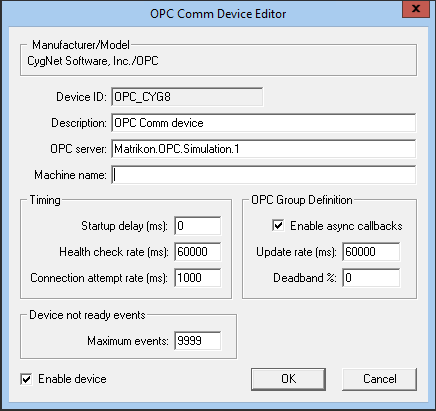
The OPC Comm EIE communication device provides a connection between an OPC remote device EIE and an OPC server. The interface allows a user to display and edit data used to identify and configure a connection to an OPC server.
Note: The OPC Comm device can only be paired with the OPC remote device EIE. The devices are non-functional without this exact combination.
See OPCIS vs OPC EIEs for a feature-by-feature comparison of the OPCIS with the OPC EIEs (OPC EIE, OPC Comm EIE, OPC Lufkin EIE, and OPC Weatherford EIE) to help you decide which OPC option best suits the requirements of your enterprise.
Click the following image to see an example Device Editor:
A 64-bit version of this EIE is available. See 64-bit Device Drivers.
The following table lists and describes properties for the OPC Comm Device Editor dialog box.
| Property | Description |
|---|---|
|
Device ID |
The unique identifier of an instance for this device. This free-form name must be unique in the DDS and the FAC. That is, it must be a name not used by any other communication device, import/export device, remote device, or facility. Valid characters are A-Z, 0-9, dash (-), underscore (_), and tilde (~). No spaces are allowed. 20 character maximum. Note: Tilde (~) is a valid character for both devices and facilities, but its use is not recommended. |
|
Description |
A free-form description of the device. 32 character maximum. |
|
OPC server |
The name of the OPC server (either the PROGID or CLSID from the registry) with which the comm device is communicating. |
|
Machine name |
Specifies the name of the remote computer on which the OPC server is running. Both UNC (for example, \\SERVER or SERVER) and DNS (for example, server.com or IP address) formats are acceptable. Note: The machine name may be blank if the server is running on the same machine as the UIS. |
| Timing | |
|
Startup delay (ms) |
Specifies the delay time (in milliseconds) to allow an OPC server to initialize before OPC groups are defined. Default is 0. |
|
Health check rate (ms) |
Specifies the rate (in milliseconds) at which the OPC Comm EIE performs a health check of the OPC server. Default is 60000. |
|
Connection attempt rate (ms) |
Specifies the connection attempt rate (in milliseconds) for the OPC Comm EIE to connect with the OPC server. Default is 1000. |
| OPC Group Definition | |
|
Enable async callbacks |
When checked, the OPC server will push data to the OPC EIE as it obtains changed values from the remote device. |
|
Update rate (ms) |
The option selected for Enable async callbacks determines the parameters available for the update rate (in milliseconds). Default is 60000.
|
|
Deadband % |
Deadband percentage is an OPC standard capability that requests that an OPC server only report value changes that exceed a configured percentage. Type a percentage value for the OPC group definition. The default value is 0. |
| Device not ready events | |
|
Maximum events |
The Device not ready events field sets the maximum number of failed attempts to connect to a field device before the communication device reaches a "Not Ready" state. If a communication device reaches a "Not Ready" state, the existing queue is emptied and new messages are not queued. You can reset the communication device by disabling and then re-enabling it, or you can enable the communication device using script. |
|
Enable device |
Check to enable or disable the device. The default setting is disabled. The device will automatically disable if an invalid configuration is detected. The device can be re-enabled after the invalid configuration is fixed. |

|
|
|

